
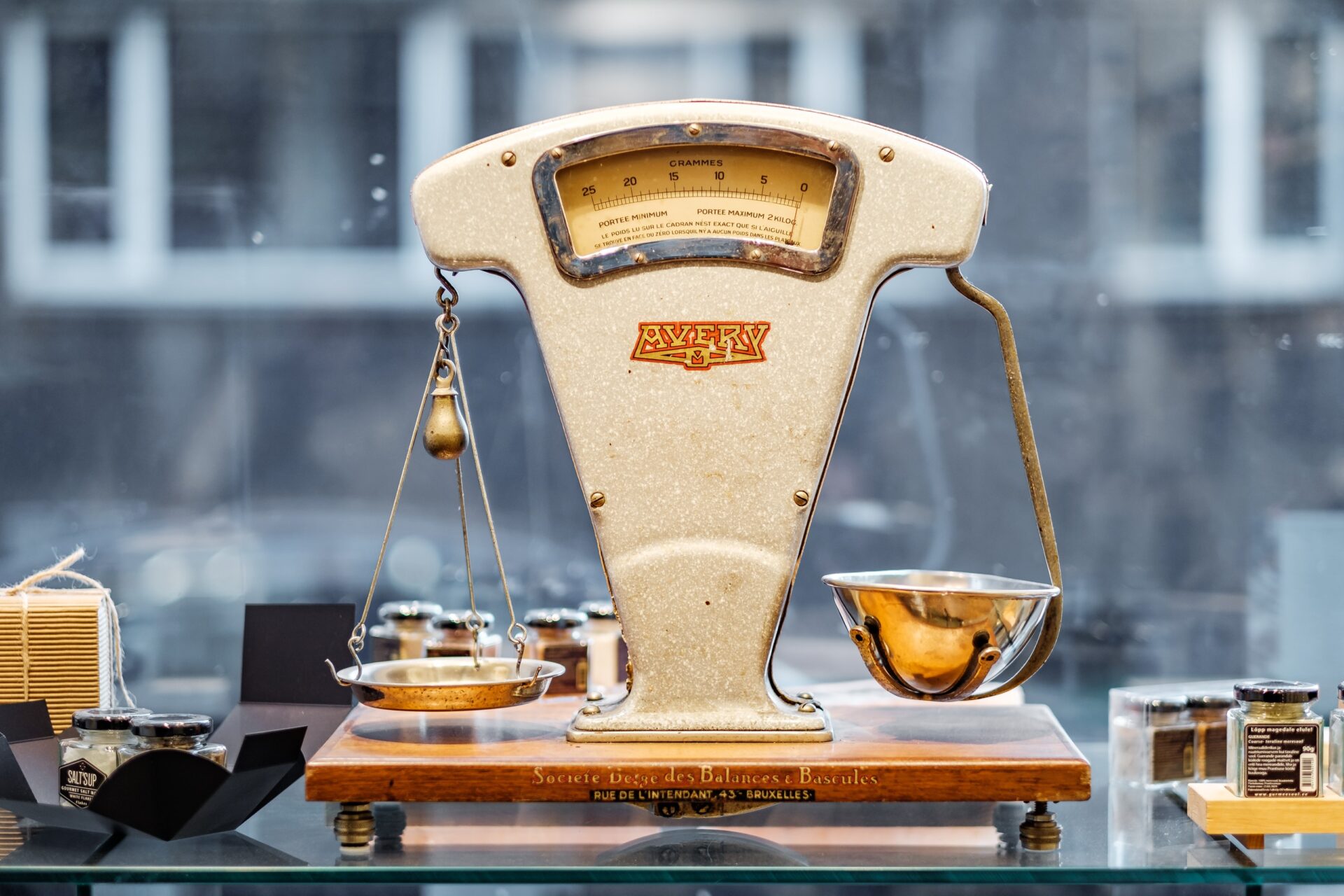
Good credit management creates balance
Is your company already doing credit management?
Finding the right balance is essential in this process, and for every company and industry that balance is different.
A too strict follow up may result in missed sales and profits, a too lax approach on the other hand may quickly set the precedent that late payments are acceptable.
5 important tools
The ultimate goal ofcredit managementis to optimize cash flow and thus to keep DSO (Days Sales Outstanding, a Key Performance Indicator)low.
The road to this optimization is not straightforward, but we can provide some important and easy to implement tools:
1. Know your clients
Credit management is not only about managing the numbers, but certainly also about managing your customers (contacts).
Personal contact is always preferred here, but is generally less feasible for large companies than for SMEs. The quality of the contact plays an even greater role: know what you are talking about (know the file), know who you need to speak to (who are the contact persons?) and know how to reach your contact persons (correct contact details such as direct telephone numbers and e-mail addresses are essential).
This not only provides an administrative advantage, but also gives the contact a sense of familiarity. Listing this type of data does not require a sophisticated computer system, but it is a time investment that will pay off in the long run.
Also map out your customers’ credit risks. If a company scores well on solvency and paying outstanding invoices,payment terms may be relaxed to retain the customer.
2. Communicate the rules of the game in advance via general conditions
Good credit management can act situationally and relax the payment rules to keep the balance in the middle, but first the rules must be well known and understood by the customers.General terms and conditionssummarize these rules. So make sure that general terms and conditions are demonstrably accepted (signature, check mark on online form, …) before executing the service.
State them on the order form, the invoice, the website, etc.Mentioning them is not the same as referring to them! For example, it is not enough to refer to an online link.
Refer clearly to the payment terms, the risks if these payment terms are not respected (penalties such as costs and interest), whose general terms and conditions prevail, which legislation applies, how to dispute, etc. … . The legislator does, however, require that your general terms and conditions be balanced! Avoidunlawful termssuch as those which do not respect the principle of balance.
3. Have the necessary (traceable) communication at hand
A key pillar of strong credit and accounts receivable management is proper documentation!Send invoices to your customers immediately after delivery of the good or service. The later a customer receives an invoice, the later payment will follow. If this invoice is then also sent in a traceable format (e.g. via e-mail),possible future disputes(about receipt of the invoice, costs and interest, etc.) can be warded off and payment can thus be accelerated.
This also applies to the (signed) order form, delivery slip, complaints that were followed up, etc. When a customer reports not having placed an order, not having received the order in time, or any other problem: the proof printed in black and white comes to your aid and speeds up the resolution of the outstanding debt.
4. Send reminders
Good credit management or debtor management anticipates potential defaults and sets out the guidelines for a reminder system. Determine the maximum delay for payment, the number of reminders that will be sent to the debtor and the intervals between these reminders.
Note: sending reminders is your own decision, and (for the time being)not an obligationfrom the government (unless you are a telecom operator)! Debtors do appreciate reminders very much in our experience.
5. Ask for external help
When unpaid invoices completely tip the balance, when you would rather spend more time on your core business, or when you would rather have a more balanced work life, there is always the option of outsourcing the collection of those unpaid invoices.
TCM Belgium is a Belgian collection agency that also operates internationally in more than 100 countries, and is also complementary to your internal credit management. We help you with that one difficult debtor, but we can just as well follow up on a whole batch of unpaid invoices. The aim of our intervention is to save you time, so we have made sure that thistransferis particularly smooth!
For more info about our help in collecting unpaid invoices,contact usat info@tcm.be or +32 16 74 52 00.
04/05/2022
Related
Related News

Samsonite collects via TCM – Testimony
For Samsonite, one of TCM's many advantages is their personal approach for debt collection claims both on national and international level. << The Samsonite success story started in 1910 in....
Learn More- May 18, 2016
- Kim Rutten

Debt collection in China
TCM China, established in Qingdao in 1997, has 35 branches in major city of China and hundreds of offices in smaller cities. TCM China has 2000 people on it payroll.....
Learn More- July 20, 2016
- Kim Rutten

Who could help me getting invoices paid?
Whether you are a private person, a SMEntreprise (99% of businesses in Europe) or a multinational, unpaid invoices are a painful and delicate matter. It is usually a source for....
Learn More- October 31, 2016
- Kim Rutten
Our Partners
We are recommended by the following Belgian business federations


